


Money and language: Transaction and tension

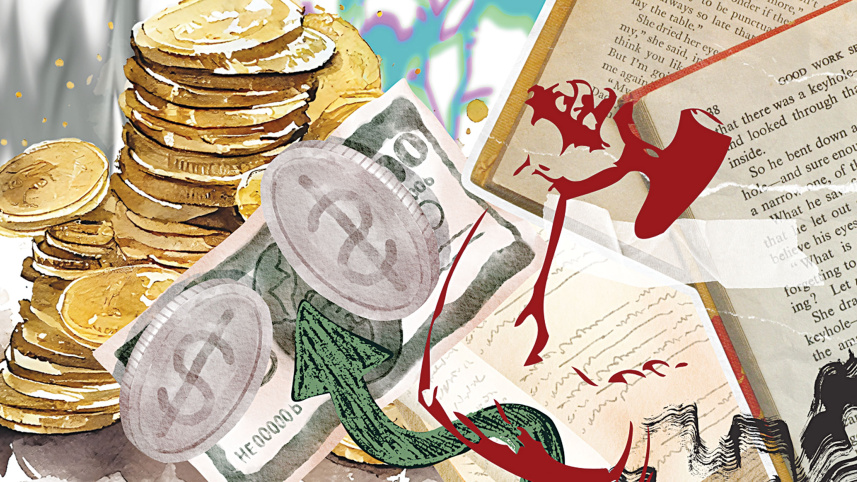
In addition to today’s transnational corporations and the global explosion of their advertisements, the works of William Shakespeare and Karl Marx keep teaching us a great deal about the relationship between money and language. It is more than intriguing that Marx is an ardent Shakespeare aficionado, one who does not merely quote Shakespeare at whatever chance he gets, but one who suggests that Shakespeare has an acute sense of political economy; that Shakespeare effectively and instructively dramatises an interplay between the economic and the linguistic.
In his early work Economic and Philosophical Manuscripts of 1844, particularly in the chapter called “The Power of Money in Bourgeois Society,” Marx enthusiastically quotes from Shakespeare’s play “The Timon of Athens” (1623) to make certain points about the God-like power of money which is also the power of language itself: “[. . .] Thou visible God! / That solder’st close impossibilities,/ And makest them kiss! That speak’st with every tongue, / To every purpose! O thou touch of hearts!”

Yes, money speaks with every tongue—it’s Marx’s Shakespearean point, or perhaps Shakespeare’s “Marxist” point.
And, more clearly than ever before, capitalism today as a mode of economic production continuously evolves and enacts its own tongue—its own suitable mode of linguistic production—while also tending to globalise and even universalise it by transforming money into the most powerful, attractive, magnetic, and even erotic language, while suggesting thereby that to have money is to have language—the language of power and beauty and sensual gratification all at once.
In fact, in his chapter “The Power of Money in Bourgeois Society”—a chapter I’ve already invoked and one that reads, to me, like a Baudelairean prose-poem—Marx sharply underlines the language-like quality of money and the money-like quality of language, while also adumbrating the erotic nature—call it the “erotic value”—of money itself. For what is it, after all, that systemically juxtaposes the female body and hard cash? And then, mark this: capitalism has already cashed in on that very nexus, with one Miss Universe presenting a striking image of her body wrapped in nothing but cash—cash and more cash—rendering visually concrete the point that money is not merely corporeal but irresistibly sexy. And, indeed, what is it that transforms the female body into an eroticised yet commodified language-on-sale from the striptease to the mainstream media to the international body industry? The answer is: the stubborn logic of capital itself.
And from the perspective of capital, if language does not have an exchange-value in the strict political-economic sense of the term, language ceases to be language as such. But in the process of producing and reproducing what might be called capitalism’s money-language or language-money—that is, language itself as an exchange-value—capitalism also tends to homogenise, appropriate, destroy, and sometimes even flexibly accommodate spaces for different kinds of languages, including oppositional or “trouble-making” ones. VN Volosinov—the Russian philosopher of language—justly asserts: “[…] the ruling class strives to impart a supraclass, eternal character to the ideological sign [say language], to extinguish or drive inward the struggle between social value judgments which occurs in it, to make the sign unidaccentual.”
Money uniaccentualises; so does the language of money, and by extension the language of capitalism. This, I submit, is a fundamental tendency of a capitalist mode of linguistic production. Yet another foundational tendency—one that underlies and even governs this very mode of production—is its drive to standardise and institutionalise language in such ways that language cannot be equally accessed or equally owned by its users within a given social space or community.
Thus, language becomes a site of class struggle and other forms of contestation—a contestation over the ownership of the “standard” means of linguistic production. And, thus, of course there are conflicts between those who use, say, so-called “polished” or “correct” language and those who do not. (Think of those card-carrying Tagore enthusiasts in our country—ones whose frowns tend to multiply with a vengeance when you deviate from what they call “standard” Bangla. And think of those deshi shahebs as well—ones who are out there to police your damn accent, as you speak English. If, for instance, your accent falls on the “wrong’ syllable, you are surely damned in the regime of our deshi shahebs! The cultural logics of class and colonialism go hand in hand either directly or secretly, you bet.)
But a capitalist mode of linguistic production cannot totally exhaust or extinguish other—and othered—modes of linguistic production. True, the history of capitalism—in tandem with the history of colonialism (Edward Said rightly characterises these histories as “intertwined” in Culture and Imperialism)—is a history of othering and even destroying indigenous languages. One only needs to think of the global spread of English since the emergence of early modern capitalism. Its linguistic imperialism has directly perpetrated violence upon numerous indigenous languages across the world.
Yet the history of capitalism also tells us that capitalism not only devalues and destroys but simultaneously generates its own opposites—its Other. Thus, in a world under capitalism, on the one hand we encounter the production, exchange, distribution, and consumption of languages such as “Open Happiness!” (one of Coca-Cola’s slogans) and, on the other, we witness the production and exchange of languages that erupt as outcries of the Other—like the Latin American feminist poet and activist Nora Mendez’s scream: “Ana Maria furious/ when they would touch her child / when they would bleed her land.”
Acutely aware of how “the company also corrupted prose”—to use the Nicaraguan Marxist poet-priest Ernesto Cardenal’s line—the South Korean socialist-shaman Kim Chi Ha mobilises in the very language of the body his counter-imperatives against the capitalist mode of linguistic production:” Speak, speak / With torn body/ Every wound / As an open lip /As an open tongue. Kim Chi Ha also reproduces the language of mass-rage in his famous poem called “Hunger:” “I could devour animals by the hundreds, thousands—hard ones. / I want to eat pork, put away fat ones. / I will eat you. / I’ve been driven mad by long starvation./ […] I’ll even eat human flesh./ Ah, I’m so unbearably hungry. / I could eat money.”
Let me cite some other imperatives so as to see how language itself turns out to be an area of both oppression and opposition. Let’s recall that in one of his national addresses on the the war against so-called terrorism, George W. Bush once unleashed certain categorical imperatives and assertives such as: 1) “America is asking what is expected of us,” 2) “Go about your business,’ 3) “Fly!,” and 4) “Enjoy life!” How distant and different, then, are Coca-Cola’s’ value-driven imperatives from those presidential ones— produced, exchanged, distributed, and consumed as they were in the US?
Given the variously orchestrated class-alliance between the managers of nation-states and corporate capitalists themselves, it is immediately arguable that all those imperatives cited above are nothing but linguistic commodities which are produced, packaged, distributed, and consumed within the same capitalist mode of linguistic production. As Marx once put it in his Shakespearean twist, “commodities are in love with money, but the course of true love never did run smooth.” One can also say that language is in love with both commodities and money, but the course of such love does not run smoothly. For a capitalist mode of linguistic production—like capitalism in general—keeps inviting and encountering oppositions and obstacles.
Thus, in our world, a street singer screams at the top of his voice: “we’ll do it our way;” or the poet Gcina Mholpe writes, “Say No, Black Woman / Say No / When they give you a back seat / in the liberation wagon / Say No / Yes Black Woman / A Big NO;” or, for that matter, the South African poet ANC Kuamalo tells us: “Let’s have poems / blood-red in color / ringing like damn bells / Poems / that tear at the oppressor’s face / and smash his grip.”
Indeed, the lines cited above are all instances of oppositional modes of linguistic production—modes that underscore not only that language, like money, is certainly a medium of exchange, but also that language can be at least threatening to the very system that produces money, not of course as the “Self-causing Cause”—to invoke Spinoza’s famous definition of God—but as a language-inf(l)ecting material force.
But how did Shakespeare respond to the power of “merchant capital”—that very historical form of capital dominating his world in the sixteenth and seventeenth centuries? Of course, it would be far too quick, even simplistic, to claim that Shakespeare was some out-and-out anti-capitalist playwright. Yet one does find suggestive moments of rebellion and resistance in his work—moments when Shakespeare gives an oppositional language to none other than King Lear. In Act 4, Lear rages against a machine—a system predicated on the logic of accumulation and profit: “Let the superfluous and lust-dieted man / That slaves your ordinance, that does not see / Because he does not feel, feel your power quickly; / So distribution should undo excess, / And each man have enough.”
Yes, “distribution should undo excess.” And yes, “each man”—everyone—“have enough!” Shakespeare not only describes the nature of money with uncanny brilliance, as Marx himself suggested, but also calls—via Lear—for a principle we might name without hesitation: distributive justice. And the question practically asks itself: Can we imagine a “new” Bangladesh that attains, at the very least, this distributive justice?
Indeed, if it is true that “without a revolutionary theory there can be no revolutionary movement,” it is also true that without a revolutionary language there can be no revolutionary movement, although language alone cannot change the world. But, surely, language is a crucial site of both political and cultural struggles for both the dominant and the subjugated, both the complicit and the contestatory. Language is—among many other things—a weapon provided you know how to hold it right.
Dr Azfar Hussain is director of the graduate programme in social innovation and professor of integrative/interdisciplinary studies at Grand Valley State University in Michigan, US. He is also Summer Distinguished Professor of English and Humanities at the University of Liberal Arts Bangladesh (ULAB) and vice-president of the US-based Global Center for Advanced Studies.
 For all latest news, follow The Daily Star's Google News channel.
Comments