
Samba meets reality

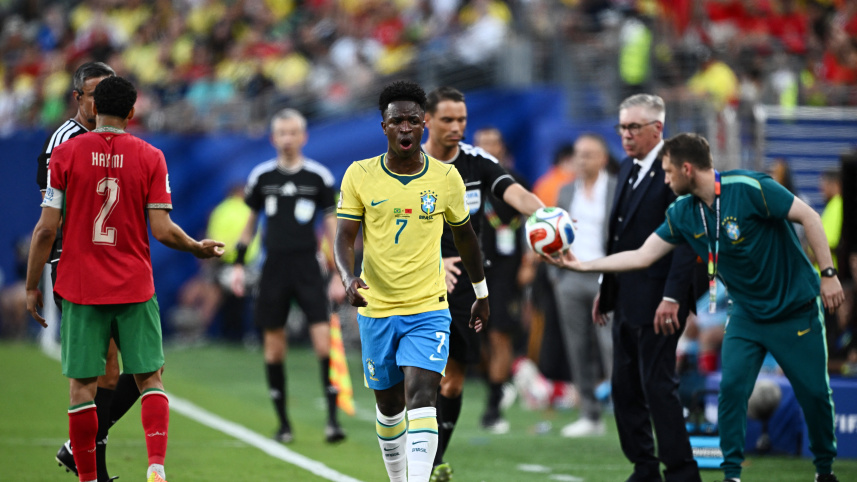
Romanticism, Samba nostalgia, and the weight of a record five World Cup titles -- all of it met a sobering dose of reality as Brazil began their Hexa campaign with a 1-1 draw against Morocco at the New York-New Jersey Stadium on Sunday. What was expected to be another reminder of their enduring mystique instead turned into an early lesson in how far nostalgia alone can carry a team at this level.
For Brazil fans, there was at least the small consolation of history: for the first time in 92 years, the Selecao did not lose their opening World Cup match. For Morocco, however, the feeling was quite the opposite -- that of a team who had to walk away from a heavyweight clash having done enough to win, yet not quite taking all three points they arguably deserved.
 For all latest news, follow The Daily Star's Google News channel.
 Pre-match discussions, as they so often are when Brazil step onto the global stage, revolved around Carlo Ancelotti’s tactical blueprint and whether this squad could finally end a 24-year wait for the trophy -- a drought now matching their longest stretch since the gap between 1970 and 1994.
But once the game began, the narrative shifted quickly from expectation to exposure.
From the first whistle, Brazil looked burdened by the very identity they were trying to uphold. The pressure of artistry, the expectation of dominance, and the demand to entertain seemed to weigh heavier than Morocco’s pressing lines.
The North Africans -- unbeaten in 28 matches and still riding the momentum of their historic World Cup semifinal run four years ago -- played with clarity and intent, forcing Brazil into long spells of discomfort.
Even ahead of the game, goalkeeper Alisson Becker had remarked that managing Brazil carries more pressure than leading a nation. On the pitch, that sentiment felt less like exaggeration and more like diagnosis. For the opening 30 minutes, Brazil were not so much dictating play as surviving it.
Morocco repeatedly found spaces between the lines, advancing with composure and confidence. Their opener in the 21st minute, a deft chipped finish from Ismael Saibari, felt less like a surprise and more like a logical conclusion to their early dominance.
Even Ancelotti admitted as much afterward. “I think this was a tough match, especially in the beginning. The team was a bit anxious, nerves were everywhere,” he said in a rare public acknowledgment of a side still searching for emotional balance as much as tactical structure.
Brazil’s response came not through collective rhythm but individual brilliance. Vinicius Junior, as he so often does, provided the spark. Cutting in from the left, shifting past his marker with trademark ease, he rifled home the equaliser in the 32nd minute -- a reminder that even when structure fails, talent can still momentarily suspend reality.
But moments of brilliance only masked deeper concerns. Morocco’s performance only reinforced that their semifinal run in Qatar was no anomaly, while Brazil’s midfield once again appeared fragmented and uncertain. The blend of Bruno Guimaraes, Casemiro, Danilo Santos, Fabinho, and Lucas Paqueta lacked both cohesion and tempo. On current form, none convincingly resemble the world’s elite midfield cores, and comparisons with the fluid genius of past icons only sharpen the contrast.
Casemiro, despite a strong club season, often looked isolated against a Moroccan midfield brimming with energy, technique, and youthful ambition -- particularly Ayyoub Bouaddi, whose debut World Cup performance underlined the growing gap in dynamism and invention.
Structural concerns extended further. Out of position deployments -- including centre-back Ibanez at full-back -- only added to the sense of improvisation under pressure, and Morocco were quick to exploit those vulnerabilities.
There is still time, of course. Neymar’s return from injury in the next match against Haiti offers both hope and narrative lift. But Brazil’s challenge is no longer simply about returning stars or recalling memories of past greatness. It is about building a team that does not rely on either.
As Ancelotti put it simply, “We didn’t play well, but we cannot lose heart.” That may be true -- but heart alone cannot be mistaken for structure, and nostalgia alone cannot be mistaken for strategy.
For Brazil, the Samba spirit is not entirely gone. But it is no longer enough on its own. It must evolve, or risk becoming nothing more than memory dressed up as expectation.




Comments